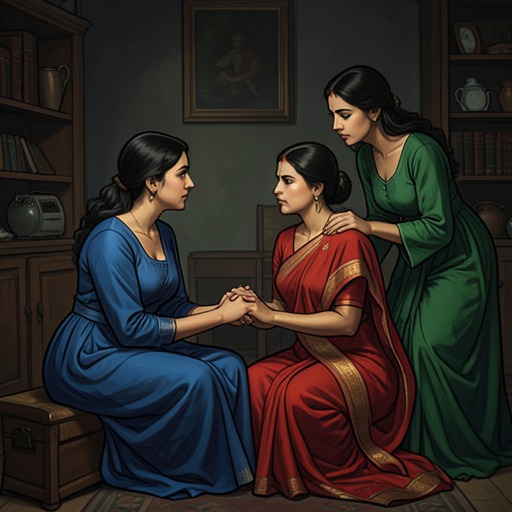
Manimekalai’s love for Vandhiyathevan
Ponniyin SelvanManimekalai’s love for Vallavarayan Vandhiyathevan grows from a vivid imagined courtship into an attachment tested by family ambition, a brother’s accusation, and the conflict between desire and loyalty. Before she knows Vandhiyathevan herself, Kandamaran’s stories make him a hero in her imagination; after a brief, shy glimpse of him at Kadambur, the invented beloved becomes a real person she cannot simply banish from her thoughts. Her love remains unresolved in the available account, but its consequences are already tangible: it changes how she regards marriage, alters her relationship with her brother, and gives shape to her confidences with Pazhuvoor Ilaiya Rani.
An imagined beloved
For the last two or three years of Kandamaran’s military service, he returned with glowing accounts of his friend Vallavarayan Vandhiyathevan. He praised Vandhiyathevan’s courage and intelligence, compared his beauty with that of the god of love, his martial prowess with that of the archer Arjuna, and his strategic ability with Krishna’s. Kandamaran even announced that such a man would make the right husband for his sister and provide the firm hand needed to curb her unruliness. His praise was part boast, part teasing, but it gave Manimekalai a character to imagine long before she had met its subject.
She answered her brother’s extravagant recommendations with mockery, challenging him to bring this paragon home so that she could test her own wit against him. Yet the teasing had an inward consequence. Manimekalai began conversing with an imagined Vandhiyathevan: she talked and laughed with him, sang snatches of songs, staged mock battles, and fashioned reconciliations. She shared these daydreams with friends willing to listen to her accounts of her brother’s wonderful friend. The romance was at first made of stories and invention, but the emotional investment was not merely playful; it prepared her to recognize Vandhiyathevan as the beloved when she finally saw him.
Marriage plans and a first glimpse
About four months before the account, Kandamaran’s praise changed into open hostility. He urged Manimekalai to forget the friend he now described as an orphan without family, position, or status, and presented a grander future for her. Her family, he explained, intended her to marry Madhuranthaka Thevar, who was already married to Chinna Pazhuvettarayar’s daughter. Kandamaran portrayed Madhuranthaka as a future king of Chozha Nadu and Manimekalai as a future empress; their son, he suggested, might eventually have a claim to the throne. Her parents approved of the prospects he had outlined.
Manimekalai rejected that future. She had heard that Madhuranthaka was austere, wore rudraksha beads, had never fought in battle, and was already married. She also resented what she understood as the pride of the royal women of Thanjavur, who looked down on women from other territories. Her disgust deepened when she learned that the person concealed in Pazhuvoor Ilaiya Rani’s closed palanquin during the visit to Kadambur had been Madhuranthaka, not the queen. To Manimekalai, his hidden arrival made him seem a coward masquerading as a woman, and confirmed her refusal of the proposed match.
Vandhiyathevan, meanwhile, had also come to Kadambur, but Manimekalai was too shy to approach him openly. She hid behind the other women in the women’s quarters. Although she saw him for only a short time and in brief, stolen glances, his face, smiling eyes, voice, and a few casual words stayed with her. The scene marks a change in the nature of her attachment: what began in the repeated play of imagination now had a remembered face and voice. She still did not speak with him at length, but the fleeting encounter intensified the feeling already formed through Kandamaran’s stories.
Love against a brother’s accusation
Manimekalai covertly made clear to Kandamaran that her heart belonged to Vandhiyathevan. The announcement enraged her brother, who responded first with argument and finally with a threat. He said that Vandhiyathevan was not his friend but his greatest enemy, accused him of stabbing him in the back in Thanjavur, and displayed the long scar on his own back. Kandamaran also said that his recovery was due to the devoted nursing of Pazhuvoor Ilaiya Rani. He demanded that Manimekalai reject Vandhiyathevan if she felt any loyalty to him, and threatened that both she and Vandhiyathevan would meet death at his hands if she married the man he believed had tried to kill him.
The accusation put Manimekalai’s love into direct conflict with her affection for Kandamaran. She cherished her brother, so the prospect of marrying someone he regarded as his would-be assassin became unthinkable to her. She resolved to remove Vandhiyathevan from her heart, but the effort failed in practice: his laughing face returned unbidden, in waking reverie and even in sleep. The difference between choosing to renounce a love and being able to forget it becomes central to her story. Her feelings do change under the pressure of family loyalty, but memory keeps resisting the decision she has made.
The strain also alters her usual liveliness. Once known for ruling Kadambur palace with commanding energy and for a life full of song, dance, and playful interruptions, she becomes a sorrowful, depressed young woman wandering through the palace. The elders assume that her distress concerns marriage, and her companions try to cheer her with teasing and games, without success. Her spirits lift somewhat when her family abandons the plan to marry her to Madhuranthaka, but new hints suggest another proposed match: marriage to Aditha Karikalan, the emperor’s eldest son and crown prince. Relief from one unwanted future therefore does not settle the question of what Manimekalai wants or what her family may decide next.
Confession and uncertainty
In a later conversation with Pazhuvoor Ilaiya Rani, Manimekalai asks whether apparitions can be real and whether a person can seem present when absent. Pazhuvoor Ilaiya Rani explains that overwhelming love, like overwhelming hatred, can make someone see a person everywhere, and invokes stories of Kamsan seeing Krishna and a devoted maiden finding Krishna’s form in pillars, trees, and a flooded river. She uses these examples to prompt Manimekalai to disclose who has occupied her attention. Manimekalai admits that she first saw Vandhiyathevan four months earlier, after hearing so much about him from Kandamaran. Since their meeting, he has appeared frequently in her dreams and sometimes during the day with such lifelike clarity that she experiences him as present.
Pazhuvoor Ilaiya Rani identifies Vandhiyathevan as the man who has captured Manimekalai’s heart, and Manimekalai confirms it. Her confidante asks why she does not tell Kandamaran plainly, why she allows marriage prospects with Madhuranthaka to continue, and why she has drawn Aditha Karikalan to Kadambur and insisted on the queen’s presence. Manimekalai answers that her brother dislikes Vandhiyathevan, then explains the reason: Kandamaran seems to have been stabbed in the back in Thanjavur and nursed back to health at the queen’s palace.
Manimekalai also reports a contrary account that she has heard directly from Vandhiyathevan. He swore that he did not stab Kandamaran; according to his version, someone else committed the attack, and he himself carried Kandamaran to safety after finding him by the walls of Thanjavur Fort. When Pazhuvoor Ilaiya Rani asks when he made her his confidante, Manimekalai says that it was the previous day. The exchange does not establish which account is true, but it reveals that Manimekalai is no longer relying only on her brother’s judgment: she has heard Vandhiyathevan’s denial and has brought the contradiction into the open.
The meaning of an unfinished attachment
Manimekalai’s love is shaped by the distance between the hero made from Kandamaran’s praise and the man she has glimpsed and spoken with. Before their meeting, imagination supplies the courtship; afterward, brief appearances and remembered words sustain it. His recurrence in dreams and daytime visions gives the attachment a presence beyond actual encounters, while her attempt to forget him demonstrates that this persistence is painful as well as romantic.
The feeling also exposes how little control Manimekalai has over the marriage plans made by her family. She refuses Madhuranthaka, feels bound to Kandamaran when he accuses Vandhiyathevan, and then faces hints of a possible match with Aditha Karikalan. Her own preference is clear, but it cannot by itself resolve the political and familial arrangements around her. Nor does the evidence conclude her relationship with Vandhiyathevan: it leaves her love alive, her brother’s accusation contested, and her future unsettled. The most decisive change is therefore not a marriage or a reconciliation, but Manimekalai’s movement from private daydreaming to an explicit confession of whom she loves and why that love has become difficult to act upon.